
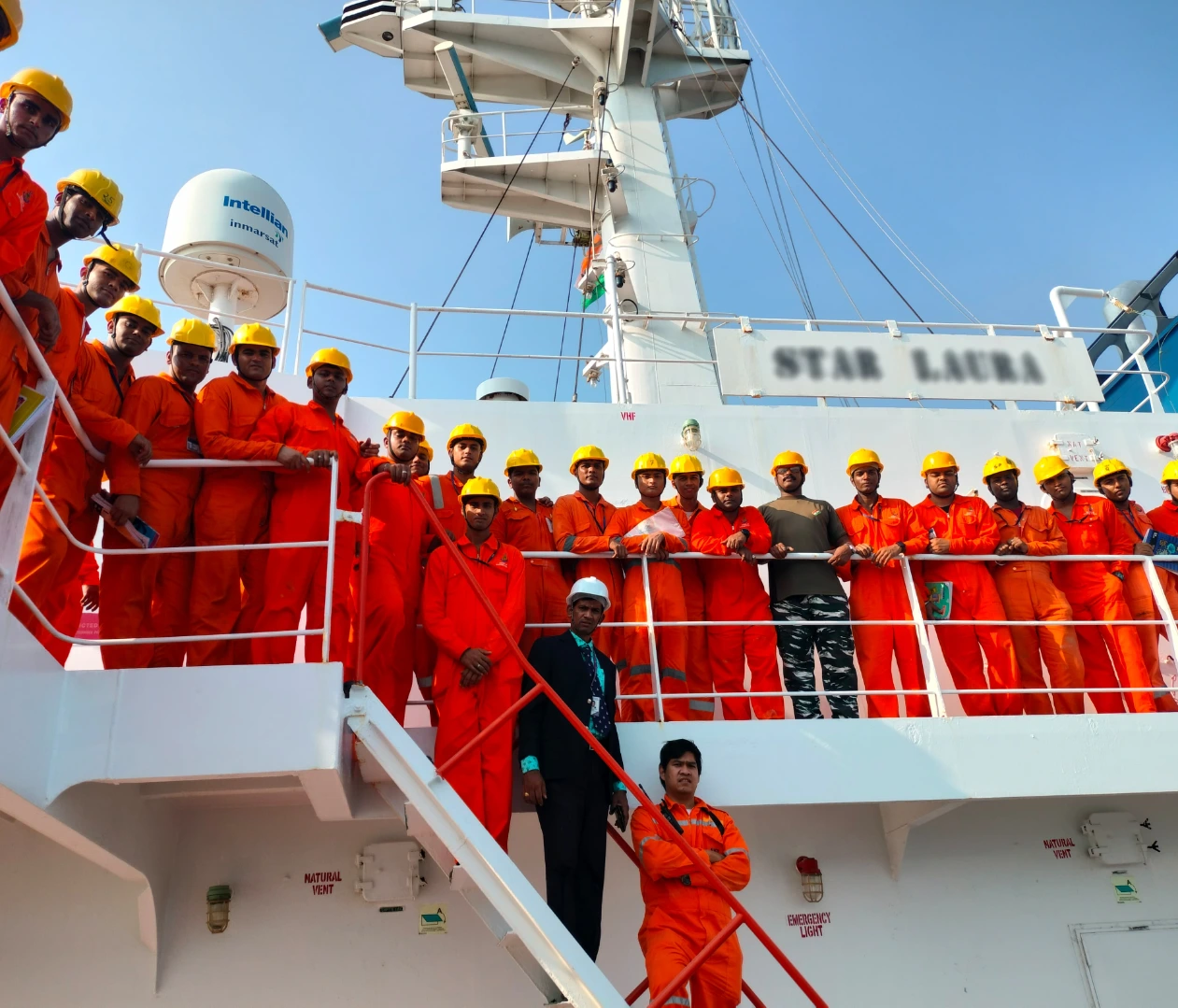
Are you a candidate dreaming of a career in the merchant navy? You are not alone. Every year, thousands of science students from Kerala aspire to sail the seas as a Deck Officer and pursue opportunities at sea. Without proper guidance on academic qualification, IMU CET entrance preparation, and DNS Sponsorship processes- often prevents aspirants from taking the next step confidently.
At Radiant Study Centre, a leading Merchant Navy coaching institute in Kerala, we provide comprehensive IMU CET coaching along with complete Deck Cadet career guidance: from eligibility criteria to sponsorship assistance.
Below are the most frequently asked questions from aspiring Merchant Navy students and parents.
Frequently Asked Question
1. What are the qualifications required to become a Deck Cadet?
The eligibility criteria are set by the Directorate General of Shipping (DG Shipping), Government of India:
- For 10+2 Science Students: You must have studied Physics, Chemistry, and Mathematics (PCM) from a recognized Board, with a minimum of 70% marks in PCM subjects and in aggregate.
- For B.Sc. Graduates: Physics must have been studied as an individual subject in at least one year of B.Sc., with a minimum of 65% marks in the final year. You must also have cleared 10+2 with PCM.
- For BE / B.Tech Students: A degree from an IIT or a college recognized by AICTE/UGC/DEC qualifies you directly.
- English Requirement: Minimum 60% marks in English as a separate subject at 10th, 12th, or degree level: from a recognized board or university.
- Age Limit: Not more than 25 years at the time of course commencement.
- Medical Fitness: You must be medically fit as per Merchant Shipping Medical Examination Rules, with 6/6 eyesight in each eye (without visual aids) and normal colour vision.
2. What is IMU CET, and why is it so important?
IMU stands for Indian Maritime University, established by an Act of Parliament with its headquarters in Chennai and campuses in Mumbai, Kolkata, and Visakhapatnam.
The IMU CET (Common Entrance Test) is a mandatory entrance exam stipulated by the Government of India. No candidate can be admitted to Pre-Sea Training as a Deck Cadet without qualifying for this exam. Every shipping company, every maritime college: all require a valid IMU CET score.
This is exactly why coaching matters. The IMU CET tests you on:
- Mathematics (10+2 level)
- Physics (10+2 level)
- Chemistry (10+2 level)
- English
- Aptitude & General Knowledge
At Radiant Study Centre, the leading IMU CET preparation centre in Kerala, our programme is designed to make students fully exam-ready with structured classes, subject experts, regular mock tests, and practice of previous years’ questions.
3. What is DNS Sponsorship, and how does it work?
DNS stands for Diploma in Nautical Science, the qualification you receive after completing the 1-year pre-sea training.
A sponsored candidate is guaranteed a sea berth (a placement on a ship) by a shipping company upon completion of Pre-Sea Training. This is not a fee sponsorship: it means the company commits to placing you on one of their ships for your onboard training phase.
Getting sponsored by a reputed shipping company is critical because:
- It ensures you have a confirmed ship placement after college
- It gives your career a structured, fully supported start
- Top companies offer exposure to various vessel types across the world
At Radiant Study Centre, we offer focused IMU CET preparation and expert guidance for DNS sponsorship from top shipping companies, helping students not only clear the exam but also successfully secure their Deck Cadet sea placement.
4. What is the difference between DNS and BSc Nautical Science?
Both DNS and BSc Nautical Science lead to a career as a Deck Officer, but they differ in structure, duration, and training pathway. Importantly, the IMU CET qualification is mandatory for admission into both programmes, as conducted by the Indian Maritime University.
1. DNS (Diploma in Nautical Science)
- 1-year pre-sea training + 18 months onboard sea service
- Requires prior company sponsorship before joining
- After completing sea time and clearing the Second Mate exam, candidates are awarded a BSc in Applied Nautical Science by IMU.
- Faster entry into sea service
2. BSc Nautical Science
- 3-year full-time residential degree programme
- Sea time is completed after the academic phase.
- Leads directly to a BSc Nautical Science degree
- Sponsorship may be arranged before or after joining, depending on the institute’s tie-ups
Key Common Requirement
For both pathways, candidates must qualify in IMU CET to secure admission under IMU regulations.
In summary:
- DNS offers early sea exposure with sponsorship-backed training.
- BSc Nautical Science follows a traditional 3-year academic structure before sea service.
Both ultimately lead to the same professional certification route in the deck department.
5. Should I join after Class XII or after my graduation?
This is one of the most common questions we get at Radiant Study Centre, and our answer is simple: join right after Class XII. It’s the smarter choice for aspiring Deck Cadets.
Here’s how the programme works:
- Year 1 – Pre-Sea Training: Complete Semesters 1 & 2 at a maritime college and earn the Advanced Diploma in Nautical Science (DNS).
- Next 18 Months – Onboard Training: Gain hands-on experience onboard ships during Semesters 3, 4 & 5, learning navigation, cargo operations, and ship management.
- Final 4 Months – Preparatory Course: Prepare for and clear the Second Mate Certificate of Competency (CoC) exam, after which you receive your BSc in Applied Nautical Science from IMU.
Joining after Class XII helps you save time and gives you a head start in building a successful maritime career.
6. I Meet the Eligibility Criteria for Deck Cadets. What Are My Next Steps?
If you satisfy the required academic and medical standards, follow this process:
- Apply Online: Submit your application to a DNS-sponsoring shipping company through their official portal. Make sure your documents and academic records are in order before you apply.
- Clear the Entrance Test: If your profile meets the criteria, you’ll be called for the company’s entrance exam. This covers PCM, English, Aptitude, and General Knowledge — all at the 10+2 level — along with a psychometric evaluation.
- Personal Interview and Medical Clearance: After clearing the written test, candidates undergo a face-to-face interview and a mandatory medical fitness assessment.
- IMU CET Qualification Is Mandatory: The national-level entrance test administered by the Indian Maritime University is compulsory for maritime admissions. Qualifying for the IMU CET is essential for admission into the Deck Cadet programme.
- Step Into Your Maritime Career: Once you secure a qualifying merit rank in the IMU CET conducted by the Indian Maritime University, you are formally admitted into the 1-year pre-sea DNS programme, marking the official start of your maritime career.
7. Is the cost of pre-sea training high?
The cost of Pre‑Sea training may seem high, but it’s important to note that the government does not subsidize it. Institutes must meet strict safety, infrastructure, and regulatory requirements, and the expenses of maintaining these standards are significant. These costs are necessary to ensure quality training and compliance with international maritime norms.
8. How to become a deck cadet in India?
Aspiring Deck Cadets must first secure DNS sponsorship from a shipping company and then clear the company’s selection test, medical examination, and interview, along with the All India IMU CET conducted by the Indian Maritime University, Chennai.
9. What does a Deck Officer do on board a ship?
A Deck Officer is responsible for the safe navigation, operational efficiency, and overall discipline of the vessel’s deck department. Core duties include:
- Keeping bridge watch and assisting in safe navigation during assigned watch hours
- Monitoring compliance with maritime safety conventions and onboard procedures
- Managing cargo operations, including loading, stowage, securing, and discharge
- Supervising deck ratings and ensuring proper execution of assigned tasks
- Inspecting and maintaining deck machinery, lifesaving appliances, and safety equipment
- Supporting the Master’s in voyage planning and operational decision-making
- Maintaining official records such as logbooks, cargo documents, and safety reports
The role requires strong situational awareness, technical knowledge, leadership ability, and strict adherence to international maritime standards.
10. Is continuous sea service mandatory during the 18-month training period?
No. The 18 months of onboard training can be completed in multiple sign-on/sign-off periods as per company schedules. What matters is accumulating the total approved sea time required by IMU and DG Shipping to qualify for the Second Mate Certificate of Competency.
11. What happens after the selection process?
Upon successfully clearing the company’s internal selection stages and qualifying in the IMU CET conducted by the Indian Maritime University, the candidate’s admission under the sponsored category is formally confirmed.
The subsequent steps typically include:
- Issuance of an official sponsorship and admission letter
- Completion of documentation and enrollment formalities
- Reporting to the designated maritime institute for the 1-year pre-sea Diploma in Nautical Science (DNS) programme
- Undergoing structured academic and practical maritime training
After successful completion of the pre-sea phase, the candidate is deployed onboard a vessel to commence the mandatory sea service period.
At this point, the transition from student to professional Deck Cadet is formally initiated.
12. Are selected Deck Cadets required to enter into a bond agreement?
Yes, most sponsoring companies require selected Deck Cadets to sign a bond.
The bond usually confirms that you will:
- Complete your pre-sea training
- Join the vessel when assigned.
- Serve the company for a specified period.d
The exact terms differ from company to company, so it’s important to read the agreement carefully and understand your responsibilities before signing.
13. What documents are required during the final admission process?
At the time of final admission into the DNS / Deck Cadet programme, candidates are required to submit original documents along with prescribed copies for verification.
Typically, the required documents include:
- IMU CET Rank Card and Admit Card issued by the Indian Maritime University
- Class X Certificate (for proof of date of birth)
- Class XII Mark Sheet and Pass Certificate (with required PCM eligibility)
- Valid Passport
- Sponsorship Letter issued by the shipping company
- Medical Fitness Certificate from a DG Shipping–approved doctor
- Transfer Certificate / School Leaving Certificate
- Government-issued ID proof (Aadhaar, etc.)
- Recent passport-size photographs
14. What is the career progression after joining as a Deck Cadet?
After joining as a Deck Cadet, the career path follows a structured and regulated progression within the deck department.
The typical advancement route is:
- Deck Cadet: Complete prescribed onboard training (sea time)
- Second Officer (Second Mate Certificate of Competency)
- Chief Officer (Chief Mate Certificate of Competency)
- Captain (Master Mariner)
At each promotional stage, the officer must:
- Accumulate the required sea service
- Complete mandatory advanced maritime courses
- Successfully cleared competency examinations conducted under the framework of the Indian Maritime University and DG Shipping.
Each stage requires approved sea service and successful completion of competency exams conducted under the regulations of the Indian Maritime University and DG Shipping.
With consistent performance and timely exam clearance, steady career progression to Captain is achievable.
15. Is sponsorship guaranteed once I clear the company’s entrance test?
No, clearing the entrance test alone does not guarantee sponsorship.
The written examination is only one stage of the overall selection process. Candidates must also complete:
- Psychometric evaluation
- Personal interview
- Medical examination
- IMU CET qualification (as mandated by the Indian Maritime University)
In summary, the entrance test is the first step; final sponsorship is granted only after full evaluation and compliance with all criteria.
16. What medical standards must I meet to become a Deck Cadet in India?
To join as a Deck Cadet in India, candidates must meet strict medical fitness standards prescribed by DG Shipping.
Key requirements generally include:
- Good overall physical health
- Normal hearing ability
- No chronic medical conditions that may affect sea service
- Eyesight within prescribed limits (including color vision standards)
- Fitness certified by a DG Shipping–approved medical examiner.
A detailed medical examination is mandatory before final selection. Only candidates declared “fit for sea service” are eligible to proceed with training and onboard deployment.
Meeting medical standards is as important as clearing the academic and entrance requirements.
17. How many attempts are allowed for IMU CET?
There is no fixed limit on the number of attempts for the IMU CET conducted by the Indian Maritime University.
Candidates may appear for the examination multiple times, provided they meet the prescribed eligibility criteria, including:
- Age limit requirements
- Academic qualifications (required PCM percentage)
- Medical fitness standards (as applicable for maritime courses)
18. Can commerce or arts students apply for Deck Cadet training?
No. Commerce or Arts students are not eligible to apply for Deck Cadet (DNS) training.
Since the Deck Cadet pathway is technically oriented and navigation-based, a science background with PCM is mandatory.
Students from the Commerce or Arts streams would need to pursue the required science subjects to become eligible.
19. What is the salary of a Deck Cadet during onboard training?
A Deck Cadet usually earns a stipend while onboard. In India, it ranges from ₹20,000 to ₹85,000 per month, with most cadets receiving around ₹27,000–₹40,000 per month.
The stipend often covers food, accommodation, and basic expenses, so cadets can focus fully on training and gaining sea experience.
20. Is a passport required before joining pre-sea training?
Yes. A valid passport is mandatory before starting pre-sea training.
Candidates should ensure their passport is valid for at least 5–10 years and keep copies ready along with other admission documents.
Best IMU CET Coaching in Kerala: Why Radiant Study Centre Stands Out
For Kerala’s aspiring Deck Cadets, the path to the Merchant Navy begins with the right preparation. At the Radiant Study Centre, we combine years of proven experience, specialized IMU CET preparation, and structured practice sessions to help students master every subject, improve speed and accuracy, and build confidence.
Here’s why Radiant Study Centre is the top choice for IMU CET coaching with DNS in Kerala :
- Comprehensive IMU CET Curriculum aligned with the exam pattern
- Experienced Faculty with deep subject expertise
- Regular Mock Tests & Past Papers with the Error Notebook system for continuous improvement
- End‑to‑End DNS Sponsorship Guidance, including documentation and career mentoring
We don’t stop at academics. Our team supports students through the entire sponsorship process, ensuring they are fully prepared for every step of their Deck Cadet journey.
With personalized mentorship and proven strategies, Radiant Study Centre helps aspirants achieve top IMU CET ranks, secure DNS sponsorships from leading shipping colleges, and confidently step into their maritime careers.
Radiant Study Centre – Kerala’s top IMU CET Coaching centre in Kerala.
Turning Kerala’s maritime dreams into successful careers.