
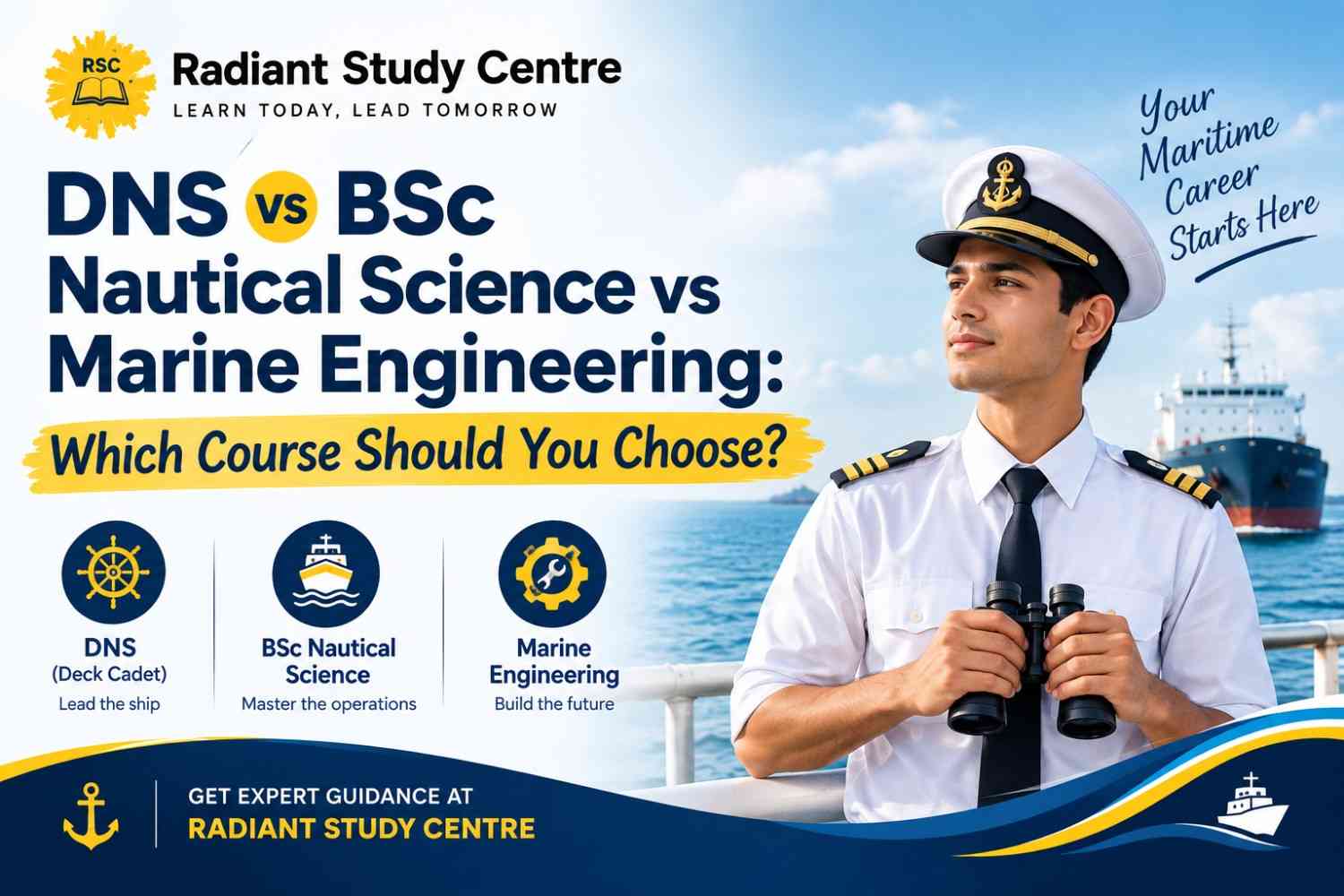
Explore Merchant Navy courses after 12th, including DNS, BSc Nautical Science and Marine Engineering. Learn about eligibility, IMU-CET coaching in Kerala and DNS sponsorship guidance at Radiant Study Centre.
Choosing the right Merchant Navy course after 12th is an important decision for students who dream of a career at sea. For students exploring Merchant Navy courses in Kerala,
options such as Diploma in Nautical Science (DNS), BSc Nautical Science, and Marine Engineering, it is natural to wonder which pathway best suits your interests, academic strengths, and career goals.
Although all three courses can lead to opportunities in the maritime industry, they prepare students for different responsibilities on board a ship. DNS and BSc Nautical Science focus on navigation, deck operations and ship management. Marine Engineering focuses on the machinery, propulsion systems and technical operations that keep a ship running.Students preparing for the entrance examination can also explore IMU-CET coaching in Kerala to strengthen their preparation.
If you are a Plus Two student planning to join the Merchant Navy, this guide from Radiant Study Centre explains the key differences between these courses, their eligibility requirements, career pathways, and the factors you should consider before making your choice.
Understanding the Diploma in Nautical Science (DNS)
Diploma in Nautical Science (DNS) is a popular pathway for students who wish to become deck officers in the Merchant Navy. The programme introduces students to the fundamentals of ship navigation, maritime safety, and vessel operations, combining pre-sea academic learning with practical training.
Compared with BSc Nautical Science, DNS offers a shorter pre-sea academic programme. After completing this stage, students must fulfil the prescribed onboard training, sea-service requirements, examinations, and professional certification criteria to progress in their maritime careers.
Key subjects covered in DNS:
- Navigation: Learn the principles of ship navigation, chart work, and passage planning.
- Seamanship: Understand shipboard operations, equipment, and safety procedures.
- Cargo Operations: Study cargo handling and ship stability.
- Maritime Safety: Learn essential safety practices and maritime regulations.
- Bridge Operations: Develop knowledge of bridge equipment and communication procedures.
Course duration: Generally one year of pre-sea training, followed by the required shipboard training and certification stages.
Career Progression After DNS:
- Deck Cadet: Gain practical experience through onboard training.
- Third Officer: Qualify for the relevant Certificate of Competency and progress to an officer role.
- Second Officer: Take on greater responsibility for navigation and watchkeeping.
- Chief Officer: Supervise deck operations, cargo handling, and crew activities.
- Captain (Master): Lead the vessel and oversee its overall operations after meeting the required sea service, examination, and certification requirements.
Who Is DNS Suitable For?
DNS may be a suitable option for students who aspire to become deck officers in the Merchant Navy and prefer a shorter pre-sea training programme. Students interested in navigation, ship operations, and life at sea should check the academic eligibility criteria, medical fitness standards, company sponsorship requirements, and shipboard training arrangements before applying.
BSc Nautical Science: Course Overview and Career Scope
BSc Nautical Science is a three-year undergraduate programme designed for students who want to build a career in the deck department of merchant ships. The course develops students’ knowledge of navigation, ship operations, maritime safety, and the principles involved in managing a vessel at sea.
The programme combines theoretical learning with practical training to prepare students for the next stages of their maritime careers. After completing the degree, students must fulfil the applicable onboard training, sea service, examination, and certification requirements to progress towards becoming qualified deck officers.
Key Subjects Covered in BSc Nautical Science
- Ship Navigation: Understand chart work, route planning, and navigational techniques.
- Ship Stability and Cargo Operations: Learn how vessels maintain stability and handle cargo safely.
- Marine Meteorology: Study weather conditions and their impact on navigation.
- Maritime Law: Understand the regulations governing shipping and vessel operations.
- Shipboard Safety: Learn safety procedures, emergency response, and bridge operations.
Course Duration: Three years of undergraduate study, followed by the applicable shipboard training and professional certification stages.
Career Progression After BSc Nautical Science
Students who complete the required training and certification can progress through the deck officer pathway:
- Deck Cadet: Gain practical shipboard experience and develop navigation skills.
- Third Officer: Undertake junior officer responsibilities after obtaining the required certification.
- Second Officer: Take on greater responsibility for navigation and watchkeeping.
- Chief Officer: Supervise deck operations, cargo handling, and crew activities.
- Captain (Master): Lead the vessel after meeting the required sea service, examination, and certification standards.
Who Should Choose BSc Nautical Science?
If you have completed Plus Two with Physics, Chemistry, and Mathematics and dream of becoming a deck officer in the Merchant Navy, BSc Nautical Science could be a good option for you. This course is ideal for students who are curious about ship navigation, enjoy learning how ships operate, and want to build a career at sea through a bachelor’s degree programme.
Before applying, make sure you meet the academic eligibility criteria, medical fitness standards, and admission requirements. It is also important to check the institute’s approval status and understand the onboard training requirements after graduation.
Marine Engineering: Course Details and Career Opportunities
Marine Engineering is an excellent pathway for students who are interested in the technical side of the Merchant Navy. Marine engineers are responsible for operating, maintaining, and monitoring a ship’s engines, propulsion systems, electrical equipment, and other essential machinery.
Students in India can pursue a four-year B.Tech or BE degree in Marine Engineering through an eligible institution. The programme combines engineering concepts with practical learning, preparing students to understand shipboard machinery, identify technical problems, and maintain the systems required for a vessel to operate efficiently.
Key Subjects Covered in Marine Engineering
- Marine Engines: Understand the working principles of ship engines and propulsion systems.
- Thermodynamics and Fluid Mechanics: Learn how heat, energy, and fluid movement affect engineering systems.
- Electrical and Auxiliary Systems: Study the equipment that supports a ship’s day-to-day operations.
- Machinery Maintenance: Learn how to inspect equipment, identify faults, and carry out maintenance.
- Engine-Room Safety: Understand safe working practices and emergency procedures.
Course Duration: Four years for a typical B.Tech or BE Marine Engineering degree, followed by the applicable onboard training and certification requirements.
Career Progression in Marine Engineering
A career in Marine Engineering offers opportunities to grow as you gain experience, complete the required sea service, and pass the necessary competency examinations.
- Trainee Marine Engineer: Learn how to operate and maintain ship machinery while gaining practical experience on board.
- Junior Engineer: Assist with daily engine-room operations and help maintain the ship’s equipment.
- Second Engineer: Take on greater responsibility for engine-room operations, machinery maintenance, and the engineering team.
- Chief Engineer: Lead the ship’s engineering department and ensure that its engines and machinery operate safely and efficiently.
Career growth depends on your experience at sea, required examinations, and professional certifications.
Who should choose Marine Engineering?
Marine Engineering may be right for students who enjoy Physics, Mathematics, mechanical systems and technical problem-solving. If engines and machinery interest you more than navigation, this pathway deserves serious consideration.
Make the Right Choice for Your Future at Sea
Choosing between DNS, BSc Nautical Science, and Marine Engineering is an important step towards your Merchant Navy career. Think about the subjects you enjoy, the kind of work you want to do on a ship, and the career path that matches your interests. If you dream of navigating ships, explore the deck officer pathways. If you are more interested in engines, machinery, and technical problem-solving, Marine Engineering may be the right fit.
Remember, choosing the right course is only the beginning. Understanding the eligibility criteria, preparing for IMU-CET, meeting medical fitness standards, and exploring sponsorship opportunities where applicable can help you move forward with confidence.
At Radiant Study Centre, we help aspiring Merchant Navy students prepare for IMU-CET and understand their available course pathways. Start preparing early, make an informed decision, and take your first step towards a rewarding career at sea.
DNS vs BSc Nautical Science vs Marine Engineering: Key Differences
|
Feature |
DNS |
BSc Nautical Science |
Marine Engineering |
|
Main focus |
Navigation and deck operations |
Navigation and deck operations |
Ship machinery and engineering |
|
Course Duration |
1 year pre-sea training |
3-year degree |
4-year degree |
|
Primary career route |
Deck officer |
Deck officer |
Marine Engineer |
|
Initial training |
Pre-sea training Shipboard training |
Degree then ship-board training |
Engineering degree, then applicable onboard training |
|
Best suited for |
Students seeking the DNS deck pathway |
Students seeking a nautical science degree |
Students interested in mechanical and technical systems |
|
Key consideration |
Sponsorship and shipboard training arrangements |
Degree admission and subsequent shipboard training |
Engineering aptitude and technical subject requirements |
The course durations mentioned above cover only the academic or initial pre-sea training period. Students must also complete the required onboard training, sea service, examinations, and certification steps to qualify as officers. These requirements vary depending on the course and the applicable Directorate General of Shipping regulations.
Eligibility Criteria for Merchant Navy Courses
Students should review the eligibility criteria for their chosen programme, including academic qualifications, age requirements, medical fitness, and the admission process, before submitting an application.
- Academic Requirements:
DNS and BSc Nautical Science generally require Plus Two with Physics, Chemistry and Mathematics (PCM). Marine Engineering degree programmes also require the prescribed science and mathematics background.
For many IMU-affiliated DNS and BSc Nautical Science programmes, the standard eligibility criteria include:
- At least 60% aggregate in PCM subjects
- At least 50% marks in English in Class 10 or Class 12
- A valid IMU Common Entrance Test (IMU CET) rank, where required
Marine Engineering has its own admission requirements, which may include IMU CET or other accepted routes, depending on the institution and applicable regulations. Check the current prospectus before applying.
Students applying for Marine Engineering after Plus Two must also meet the specific academic and admission requirements of their chosen degree programme. IMU-CET or other approved admission routes may apply, depending on the institution.
Before applying, check the latest admission prospectus to confirm the DNS eligibility after 12th, BSc Nautical Science eligibility, or Marine Engineering eligibility relevant to your chosen course. Meeting the academic requirements is an important first step towards building a career in the Merchant Navy.
How to Apply for Merchant Navy Courses After Plus Two
If you plan to pursue DNS, BSc Nautical Science, or Marine Engineering after Plus Two, follow these steps to prepare your application:
- Choose Your Course: Decide whether you want to pursue a deck officer pathway through DNS or BSc Nautical Science, or an engineering career through Marine Engineering.
- Check Eligibility: Review the academic qualifications, age limits, medical fitness standards, and other admission requirements for your chosen programme.
- Register for IMU-CET: Complete the registration process and prepare for the entrance examination if it is required for your course and institution.
- Apply to Approved Institutes: Check the current admission prospectus, confirm the institute’s approval status, and submit your application with the required documents.
- Explore DNS Sponsorship: If you choose DNS, check whether company sponsorship is required or offered under your selected admission route. Follow the shipping company’s application and selection process.
- Complete Medical Examination: Attend the required medical assessment with an authorised maritime medical examiner.
- Confirm Admission and Training Details: Before accepting an offer, verify the course structure, fees, pre-sea training arrangements, and subsequent onboard training requirements.
Planning to join the Merchant Navy? Start by checking the current admission notifications and eligibility requirements for your preferred course. Early preparation for IMU-CET and timely application can help you approach the admission process with greater confidence.
Which Merchant Navy Course Is Right for You?
Choosing the right Merchant Navy course depends on your interests, career goals, and preferred learning pathway.
- Interested in navigation and ship operations? DNS may suit you if you want to follow the deck officer pathway through a diploma and pre-sea training.
- Prefer a bachelor’s degree in navigation? BSc Nautical Science offers an undergraduate route towards a career as a deck officer.
- Passionate about engines and machinery? Marine Engineering is worth considering if you want to work with a ship’s engines, propulsion systems, and technical equipment.
- Need to understand the eligibility requirements? Check your academic qualifications, age criteria, medical fitness, and admission conditions before selecting a course.
- Planning to apply for DNS? Research company sponsorship opportunities and understand the selection process and onboard training requirements.
Take time to compare the available programmes rather than choosing based on course duration alone. Understanding what each course involves can help you select a pathway that matches your interests and long-term Merchant Navy career goals.
Why Choose Radiant Study Centre for IMU-CET and DNS Sponsorship Guidance?
Planning to join the Merchant Navy after Plus Two? Preparing for IMU-CET and understanding the DNS sponsorship process are important steps towards your goal. Radiant Study Centre supports aspiring Merchant Navy students with focused entrance exam preparation and guidance to help them understand the DNS admission and sponsorship process.
For students planning to join the Merchant Navy after Plus Two, Radiant Study Centre offers IMU-CET coaching in Kerala through its centres in Ernakulam and Calicut.
- IMU-CET Coaching: Build a strong foundation in key subjects and practise questions relevant to the entrance examination.
- DNS Sponsorship Guidance: Understand company sponsorship opportunities, eligibility criteria, selection stages, and application procedures.
- Academic Support: Strengthen your concepts through structured learning, practice, and revision.
- Admission Guidance: Learn about course requirements, medical fitness standards, and the steps involved in applying for DNS.
With IMU-CET coaching in Ernakulam and Calicut, Radiant Study Centre helps students prepare for the entrance examination and explore the DNS sponsorship pathway with greater clarity.
If you are searching for Merchant Navy entrance exam coaching in Kerala, Radiant Study Centre can help you prepare for IMU-CET and understand the DNS sponsorship process.
Start your IMU-CET preparation with Radiant Study Centre and take a confident step towards your Merchant Navy dream.